How does the foreign reveal the familiar ?
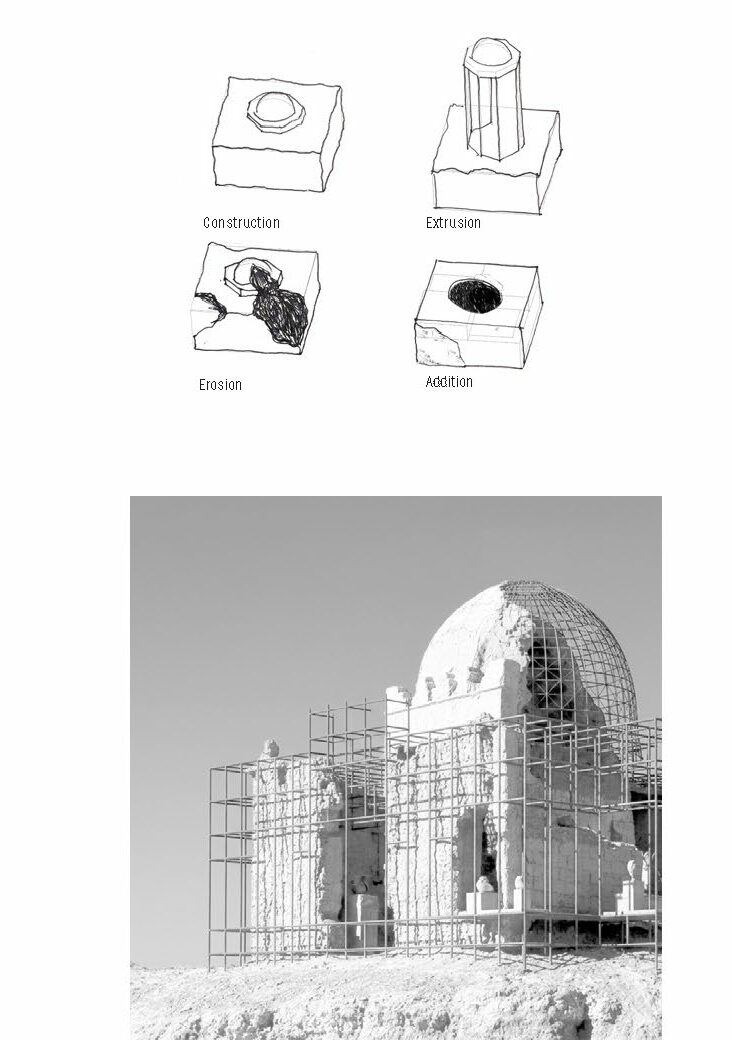
Architecture starts as a fragment, it carries within it a series of operators : time, climate, gravity, the invisible, the human hand, the machine.
Neo-Ruins sees this state of transformation as its starting point to question : How does the foreign reveal the familiar? How does the familiar inform the foreign? It is from this unresolved tension that a new architectural language is built.
This practice unfolds across multiple scales, architecture, scenography, object design. Across each scale, the same gesture: recognizing in the fragment a form of renewal
Research Projects
2026 NeoRuin I – The Marabout and The Silo, Architecture Residency, Art Omi, New York
The threaded rod through the earth block. The marabout reinterpretation holds tension within the industrial silo.
2026 Archéologies – Scenography/Exhibition Design, Fondation Dar Bellarj, Marrakech
The method made spatial: excavated earth becomes exhibition stele, metal scaffolding carries the archaeological fragment. The foreign device grafts into the existing place while holding artefacts.
2024 Bridging Ancestral Know-How and Post-Industrial Craft, Iaac-3dpa, Barcelona
A research co-written with Edouard Cabay and Alexandre Dubord, into the analogies between vernacular techniques and digital fabrication.
2024 Teixit, 3D-printed earthen prototype, IAAC/3dpa, Barcelona
The familiar informs the foreign: Hassan Fathy’s claustra logic, transmitted across generations, becomes the generative rule for a 3D-printed earthen wall.
2019 Atelier Ourika, Paris, France
A field research collective, A shared methodology for reading territory: fieldwork through multiple mediums.